
ICE OUT: The Minneapolis Insurgency and the Specter of Civil War
Presentation given by a US based comrade at Ungdomshuset during the Anarchist Bookfair on the 6th of September 2026 in Copenhagen, Denmark
I want to start by noting the vast differences between the United States and a country like Denmark, or really anywhere else in the world. I just want to make clear from the outset that perhaps a lot of what I’m going to talk about today will sound somewhat outlandish or even straight up absurd. This is both for cultural reasons as well as political ones, as the landscape is incredibly different, and has shifted rapidly over the last several years. A lot of it even caught us off guard as well. So I would like to ask for your patience in understanding these differences.
That brings me to the title of my talk today, “the Minneapolis insurgency and specter of civil war.” I’m not quite sure how anarchists and revolutionaries talk in Europe, but using words like “insurgency” and “civil war” can sometimes become empty signifiers to give the impression of something being, or wanting something to be, really intense, really militant, really extreme. It becomes kind of a quantitative term. Instead, today I am using these terms in a more specific way. I see these as qualitatively distinct forms of struggle and conflict that we experienced or anticipated in Minneapolis earlier this year. I will elaborate on what this looked like in a moment.
The pre-history of the anti-ICE conflict is likewise too extensive to really go into detail about here, so I will keep it as brief as possible. As I’m sure people are aware of, over the past twenty years, police murders of black people in the United States has frequently led to significant unrest. Minneapolis and other nearby cities and suburbs have experienced at least five different sequences of rioting between the years 2015 and 2022. The most notable, of course, was the George Floyd rebellion in 2020 which was the largest uprising the country has seen in over fifty years, or perhaps longer. It’s not a coincidence that a city with such a history of revolt like Minneapolis is targeted for the largest ICE operation in history.
Also important context is that last summer, there was a revolt against ICE operations in Los Angeles. And while Los Angeles further away from Minneapolis as we are right now from Lisbon, it set the bar for what resistance to ICE could look like in America.
A quick clarification, I’m sure people know ICE (Immigration and Customs Enforcement) deals with immigration issues. Specifically, their role is operating within the United States, while Customs and Border Protection (CBP), handles the border itself. ICE was formed after 9/11, has historically not been very large, and is a federal agency operated directly by the regime, in this case Donald Trump. This is in contrast to most law enforcement in the United States, which are commanded at the local level, primarily through city police and county sheriff departments. For example, the Minneapolis Police Department is not subordinate to anyone but the City of Minneapolis, they are not a part of a larger state or federal agency, like police are in many European countries.
ICE began executing operations in Minnesota not long after the revolt in Los Angeles. They raided a local chain of Mexican restaurants that same summer, and began to raid more frequently in the fall. Generally speaking, ICE operations at this point in time involved targeting a location for a large-scale raid, making several arrests and seizing assets. This requires a large number ICE agents to be present at the scene for a longer period of time, often several hours, and what that means is that crowds could form at the scene and resistance could spark up. The clashes at these raids in the summer and fall were relatively minor compared to what would come later, but they did happen.
In December, Donald Trump announces the beginning of Operation Metro Surge, featuring an increase in ICE activity in Minnesota. Not long after, it’s announced that they are sending two thousand ICE agents to Minneapolis. For context, that’s nearly four times the size of the Minneapolis Police Department. That’s a lot of agents. Later in January, over a thousand more agents join the operation.
I mentioned it was a small agency, so where did ICE get all of these agents? Trump’s regime fast-tracked the hiring process, so in many cases they are actually bloodthirsty fascists with no training being given military grade weapons and the idea that they have full legal immunity. And when I say fascists, I mean, specifically, like imagine the type of fascist who spends too much time in his basement on the internet. Really, they’re losers. The difference here is between the type of fascist that becomes a police officer or politician, and the one that couldn’t even qualify for that, which is a low bar. Instead, ICE will take them and give them a rifle. Plus, ICE promised a lot of money to these new hires. I think the word is a lot of them didn’t get that money—and now, they’re getting laid off.
It’s at this point that ICE begins to change their tactics so that they don’t have to conduct as many large scale raids like I just described. Rather than concentrating their own forces in one place for a longer period of time, they would rely on their mobility to target individuals when they were isolated, and abduct them as quickly as possible before large crowds could form. A single vehicle with two or three agents would follow a person home from work, or after dropping their kid off at school, and just grab them off the street. They always used unmarked vehicles too, so they would be difficult to see coming.
This change in tactics meant that the forms of resistance had to shift as well. If ICE is in one spot for a long time, it’s possible for someone from an official organization to verify an intel report before blasting it out to other activists for people to respond. That was how things had operated through activist NGO channels, up until this point. With ICE now moving so quickly, they would be long gone by the time the information could be properly “verified.”
This led to the rise of rapid response networks. People formed groups with their neighbors on Signal, an encrypted messaging app, where people could report ICE sightings and anyone in the area could respond right away. Some activists also would gather everyday at the ICE headquarters to record the license plate numbers for the unmarked ICE vehicles so that they could track them. They formed a database, so if activists saw a suspicious car they thought might be ICE, they could type in the license plate and find out if it was or not in seconds. Drivers would tail confirmed ICE vehicles around the city, so they could immediately respond to an abduction. Not to mention the infamous whistles everybody had on hand to alert everybody in earshot. Essentially, the tools to resist ICE went from being under the direction professional activists, to something anybody could do.
Because there were so many agents and they were so mobile, ICE completely saturated the city with their presence. Anyone could see an abduction happen right in front of their eyes anywhere in the city. It wasn’t abstract, like something you only saw on your phone. Again, there are thousands of agents. Everybody was seeing this reality in front of them. While commuting to work, while running errands, while at dinner, everyone saw it with their own eyes. And that’s only for those for whom it wasn’t their very own friends and family getting abducted. So everybody felt the threat and mobilized against what people began to call an occupation, not unlike the presence of U.S. troops in Kabul or Fallujah.
This comes to a head when an ICE agent murdered Renee Good on January 7th. Renee was doing what many Minnesotans had been doing and would continue to do—following ICE in her car and alerting her neighbors their presence. And in no small part due to the lack of training, at the first sign of disagreement the agent just pulls out his gun and shoots.
Unlike the murders of black people by law enforcement that led to upheavals in the past, while Renee’s death didn’t directly spark a riot, it does catalyze unprecedented mass involvement in the rapid response networks. While a lot of rapid responders had up until this point been operating within a framework of “legal observing” and claiming to not interfere with agents, the huge influx of participants meant that this framework was quickly rendered obsolete. Thousands of people learning how to follow the law when observing ICE operations represented only a small fraction of the growing movement.
I don’t know how to really convey the scale of this to anyone who wasn’t there. Organizing against ICE wasn’t a niche thing, it wasn’t subcultural. It was everybody. It seemed like every door in the city had a sign saying ICE agents weren’t allowed. Politicians supported the resistance. Businesses supported the resistance. Not even the police liked ICE, which I’ll get to in a moment.
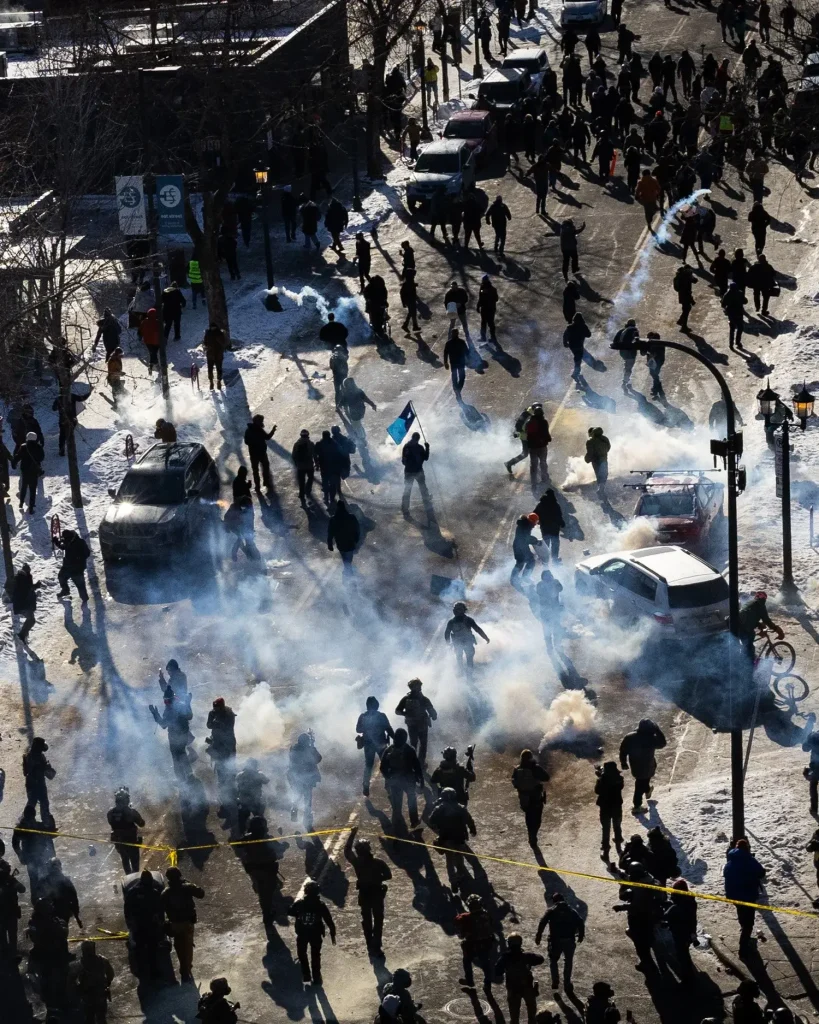
So the scene looks like this: a couple of agents jump out of an unmarked car and try to grab someone on the sidewalk, and a handful of responders immediately arrive, blow their whistles, start filming, maybe someone throws a snowball or two, the ICE agents start to panic because they are so poorly trained and have no discipline, and maybe pepper spray the crowd, which has grown from five to twenty. Then imagine this happening dozens of times a day, every day. Perhaps one of those times someone tries to attack the agents, or free the abductee, or maybe vandalize the ICE vehicle. Even if that only happens one out of ten times, or one out of fifty times, ICE start to become scared that it could happen at any time. They are quick to panic, and therefore reckless in escalating the situation in an effort to defend themselves. It got to the point that in certain neighborhoods, ICE would not conduct an arrest if they thought it might take more than two minutes start to finish. That’s how quickly a large enough crowd could show up to stop them.
Just to finish off this brief chronology—one week after Renee Good was killed, ICE agents shot someone they were pursuing, and the clashes that night were so fierce that ICE had to abandon their vehicles, which were looted and destroyed. People obtained a lot of sensitive info from them, and of course took their guns too. This was the first moment of large-scale, openly violent resistance against ICE during this sequence. Activists tracking data around deportations noted that after this night, there was a notable slow down in ICE operations in Minnesota. So this was a really important moment.
The week after that, ICE murdered Alex Pretti in a similar situation as Renee—he was responding to an ICE abduction and was shot dead in the street for it. Within an hour, burning barricades lined the streets as intense clashes raged all morning.
This would end up as the culmination of the conflict. While smaller scale clashes would continue over the next few weeks, this major battle is what would force ICE and Donald Trump to shift tactics. They fired the head of the operation, Greg Bovino, and replaced him with Tom Homan. Homan was able to implement a more sophisticated counter-insurgency strategy that relied on de-escalation and compromise, rather than brute force and escalation. Within a few weeks, they announced the surge would end, and that the troops would withdraw.
Now, why do I call it an insurgency? I am not referring to the intensity of the clashes, although some were quite intense. What I mean is that the goal was to prevent the federal government from operating in the territory entirely, which at least implicitly is to contest the government’s claim to that territory. The primary method here, rapid response, functioned by generating conflict at the site of the daily operational logistics of an enemy force. While there were more traditional protests and demonstrations, they were secondary to rapid response. If ICE agents attempted to arrest someone, people tried to stop it. If ICE agents tried to eat food in public, or use a public bathroom, people tried to stop it. When ICE agents tried to sleep, people tried to stop it.
I see this as a qualitative step forward in revolutionary struggle in the West. It moves away from the abstract realm of “politics”, where either explicitly or implicitly there is a demand made of people in power to change things, and into the material realm in which people directly intervened in the ability of those in power to carry out their intended actions. And this happened on a mass scale, over a longer period of time than most familiar uprisings.
So why also speak of civil war? I mentioned the utterly widespread nature of this insurgency. It should not be taken lightly when I mention how much support it had amongst the entire institutional Left and Democratic party including many politicians, such as the mayor of Minneapolis, many city council members, and the governor of Minnesota. Not to mention small business owners, including immigrant businesses being targeted by ICE, businesses that ran on the immigrant labor being targeted, and countless others. These factions had their own self-interests in mind, and as the movement grew it became increasingly clear that it would be career suicide to turn their backs on what was essentially their entire constituency or customer base. Opposition to ICE has defined the entire political field as well, being essentially a qualifier for the upcoming elections.
You would be correct to say this insurgency was composed of a cross-class alliance. As revolutionaries, we tend to be justifiably critical of such alliances. They generally place severe limits on any given struggle, and we have long known the radical narrative of “recuperation,” in which the capitalist class within this alliance defangs the struggle, causing it to fail. And yet, I believe what we saw in Minnesota poses a challenge to this narrative. While involvement of these politicians and business owners certainly shaped the forms of the struggle in some ways, they also simultaneously facilitated its insurgent edge. These many daily clashes would not have been possible without widespread complicity, with people getting time off work from their bosses, getting free food from supportive restaurants, and much more. And that’s in addition to the social or cultural legitimacy of fighting ICE, which was ubiquitously considered a virtue.
In this way, I have come to refer to recuperation as a kind of “tug-of-war” where the capitalist class can usually overpower the rest of us to pull people in their direction, but we are also capable of pulling others towards this insurgent position. As masses of people in Minnesota bravely resisted ICE in numerous ways, it forced Minnesota’s politicians and business owners to provide their tacit support to maintain legitimacy, which in turn helped more and more people feel comfortable engaging in open resistance. This began a process of cleaving two fractions of the capitalist class apart from each other. Thus, the mass insurgency I just explained takes on the dimension of civil war.
Meanwhile, the Minneapolis Police Department took the opportunity to reclaim some legitimacy of their own in their public opposition to ICE. Dysfunctional and understaffed since the 2020 uprising, they recognized the threat that this militarized invading force represented to their own ideal of law and order. And while they obviously did help their brethren in law enforcement when needed, they were often hesitant to do so, and even weighed the possibility of having police officers arrest ICE agents who “broke the law.” This never ended up happening, because those in charge knew what it meant. One armed law enforcement agency versus another is nothing less than the declaration of civil war. The Trump regime surely saw this as well, when they put Homan in charge and began the process of de-escalation.
The capitalist class’s desire to avoid civil war did indeed win out, with this spiral of division and escalation being diverted before it could go too far. Perhaps this diversion was inevitable. But what we saw was the initiation of process that will, in fact, lead to civil war. And if I know anything about America, it’s that diverting this process in one place and time does not mean that we won’t see it crop up again and again, in new and even weirder ways, in strange and unexpected places.
To summarize, essentially, is that the shift from the abstract political domain to the material, operational domain is the shift from impotent protest to insurgency. And the volatile mixture of insurgency with a cross-class alliance created the conditions for a possible civil war, in which one fraction of the ruling class split off from the hegemon. Undoubtedly, this alliance introduces new limits which have to be investigated and thought through as well. But for the sake of allowing as much discussion as possible, I will end here and take questions.
