
Bolivia: At the Crossroads of Insurrection and Counterrevolution
Original Text by Materiales X la Emancipacion https://materialesxlaemancipacion.espivblogs.net/
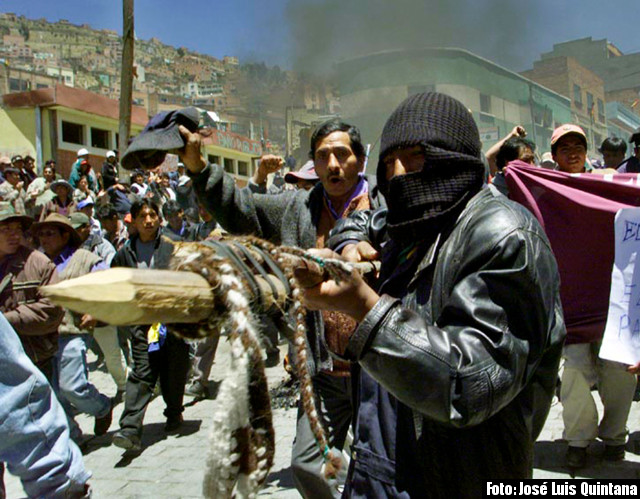
Photo by Jose Luis Quintana found on Bolivian Press
Translation by Crisis Mirror
Link to original article: https://materialesxlaemancipacion.espivblogs.net/2026/06/04/bolivia-en-la-encrucijada-de-la-insurreccion-y-la-contrarrevolucion/
SOCIAL WAR ON THE ALTIPLANO
Protests in Bolivia have intensified in recent weeks. The normality and social peace so longed for by the capitalists has been shattered. Dozens of roadblocks on strategic routes connecting La Paz with other large cities like Cochabamba, Oruro, and the border crossings to Chile and Peru were multiplying ceaselessly, despite the atrocious repression by police, military gangs, and hired thugs, to whom the proletariat has responded with genuine organized class violence.
The consumerist society, through its jackal-like spokespeople and vulture-like journalists, is rushing to spew its ideologies and racial hatred against the insurgents. First, it accuses the rebels of being, as a bloc, supporters of Evo Morales (manipulated by the remnants of MAS ideology), hiding the fact that today’s struggle in the streets is not for an obsolete figure, but rather the working class’s response to miserable living conditions and the starvation policies of the current puppets in power, who seek to accelerate the plundering of resources (water, lithium, land, minerals) and impose further austerity measures.
Meanwhile, organizations affiliated with the Bolivian Workers’ Union (COB in Spanish), mining sectors, peasant farmers, and indigenous groups intensified their protests and began demanding the resignation of President Rodrigo Paz. The “social leaders” (or rather, crisis-management bureaucrats) denounced a growing “betrayal of the grassroots by the government” and rejected official calls for dialogue. But for us, anarco-communists, all that complaining is nonsense; there is no such betrayal, for it is simply the bourgeoisie acting naturally to impose its will and ensure the continued domination of Capital.
Trade unions, far from being a weapon in the struggle against capital, are a tool perfectly integrated into the system, serving as mediators and conciliators between the ruling class and the exploited, to regulate the price of labor and prevent the working class from becoming a revolutionary force. Another of their repugnant characteristics is that they serve to channel the working class’s collective strength into narrow sectoral interests, contributing to division and fragmentation within the struggle, and fostering the illusion that each labor sector, race, or ethnic group has distinct interests unrelated to those of the others.
Just as recently happened in Ecuador with the CONAIE (Confederation of Indigenous Nationalities of Ecuador) which only served to wear down, stifle, and crush the protests, the large bureaucratic “vanguard” organizations in charge of the negotiations (is there really anything to negotiate with our class enemies?) are once again trying to lead the working class into the trap of bourgeois democratic illusions, so that everything remains the same or gets worse than before.
The government of the good-for-nothing Rodrigo Paz rushed to negotiate agreements to divide the movement, offering concessions to some of the protesting groups. It negotiated with the cooperatives, canceling a debt of 95 million bolivianos owed to the National Health Fund and maintaining the fuel subsidy. It also negotiated with the teachers’ union and the COB in El Alto, and signed an agreement with the leaders of the “red ponchos” in La Paz. Those groups gradually withdrew from the conflict. It was clear that some of the members rejected their leaders for having signed the agreement.
We would like to quote an excerpt from a text circulating online that illustrates and reinforces the point made above (even though we do not share its perspective on “workers’ democracy”), demonstrating how these mafias of “professionals of struggle and mobilization” are the true gravediggers of any revolutionary endeavor:
“Meanwhile, on the 30th of May, self-organized General Assemblies such as the one in Patacamaya—with the participation of representatives from the 77 communities in the province of Aroma—decided, as has been the case throughout the country, to reject any dialogue with the government, demand its resignation, and maintain indefinite roadblocks, thereby intensifying the protests—with 93 roadblocks today, compared to 60 two days ago—the leadership of the COB, the main labor federation, is once again shirking its responsibility and postponing—under the pretext of security—the National General Assembly, where a decision was to be made today: whether to negotiate with the government or continue the struggle until its downfall. And in an attempt to prevent this Assembly from taking place, the COB leadership has not set a date for the next one.
The COB leadership’s position is clear to everyone.
Numerous self-organized committees had called for participation in this Assembly to decide on continuing the struggle to overthrow the government, and it was certain they would secure a majority, drawing the COB rank-and-file along with them. This would effectively have transformed this open COB assembly into a self-organized national leadership for the struggle to overthrow the government. The COB leadership has shown today that it does not wish to overthrow the government and, therefore, does not want the current insurrectionary movement to be led by those at the helm.
Many consider this a betrayal.
At the same time, this comes as no surprise to many, given that the COB had already betrayed the first phase of the movement in December/January 2026, and above all, it does not discourage anyone because the self-organized committees had widely warned of what was likely to happen.
This will not destroy the movement. It will simply encourage the self-organized committees to establish for themselves the democratic national leadership [SIC!] that the movement lacks and that could have been assembled today.”
That’s how the left, the labor movement, and the civic movement operate. Today they’re leading you on a strike, but before or during the process, they’ve already sold you out to the voracious industry conglomerates and their political allies.
As long as we remain trapped in the narrative that this struggle is about defending democracy and sovereignty against the advance of the far right and fascism, we will be doomed to see the struggle play out without disrupting the structures of the capitalist system, merely shifting between governments where the nationalist bourgeoisie paves the way for the arrival of eccentric, less scrupulous bourgeoisies (the Mileis, the Noboas, the Bukeles, the Trumps).
Bolivia has a long tradition of militancy in the realm of class struggle (from the 1952 workers’ uprising to the water wars of 2000 and the gas wars of 2003). Today’s struggle has been made possible by the existence of a community and practice of struggle (a perspective of colectiveness, support networks, assemblies, logistics groups); and it is clear that, although the sheer size of a movement does not make it invulnerable, without a social base that throws itself into the struggle and supports one another, capitalism’s social peace will be imposed in a more violent manner, even if the proletariat finds itself in a situation of extreme precariousness and misery (see the case of Argentina).
And what happens after the insurrection?
On the other hand, it should be noted that today, the situation of proletarian insurrection in Bolivia does not arise within the context of a world revolution; on the contrary, it is unfolding in a vortex of counterrevolution, where the bourgeoisie is acting with desperation in its drive for capital accumulation—accelerating war, ecocide, and technological control. The actions of the bourgeois blocs representing the new forms of fascism and the new right tend to intensify class contradictions, but that does not mean our class will automatically respond eloquently and forcefully to capitalism’s attacks. It is clear that we cannot leave everything to spontaneity.
If the reformist COB is leading the struggle following the decline of the MAS, it is because, in fact, conditions have not yet ripened enough to serve as a counterweight and carry out a widespread insurrection that goes beyond the limits of timid democracy and leftism. However, overcoming this is not something that depends solely on the will of a few individuals or an organization; rather, it can only result from the shifts and ruptures inherent in the struggle itself.
Two decades of uprisings around the world confirm once again that fighting under the banners of the reformist and progressive sectors of the left condemns us to stagnation and severe setbacks that shatter the collective morale of the proletariat. It is not surprising that in Bolivia, despite the existence of a highly militant proletarian movement at this time, limitations arise stemming from confusion and apathy, which carry the risk of bringing the rebellion to a standstill.
Does that mean we should remain passive and wait “until the conditions are right”? We don’t think so. Although we know we are not even in a “pre-revolutionary” phase, that is not the end of the road, nor does it mean the struggle is over, much less our definitive defeat.
The facts on the ground reveal the proletarian struggle, not as it should be, but as it is: contradictory amid chaos and upheaval, with the inevitable interference in its early stages of interclassist and reformist elements seeking to capitalize on the situation. It will never emerge under ideal conditions or at our convenience. That is why it is pointless to isolate ourselves in the name of revolutionary purity. As agitators and revolutionaries, we must encourage the breakdown of the very organizations that have proven obsolete in order to expand the struggle—not to “improve or change them from within,” but to break them up, overcome them, and create our own autonomous organizations that serve our historical class interests… and so on, until the social revolution.
It is absurd to think that after decades of the proletariat and its structures of resistance and radical struggle having been torn apart (whether through repression or co-optation), it will suddenly rally together overnight to storm the heavens with a revolutionary program in hand and a banner bearing the inscription “Omnia sunt communia.” That is not how the class struggle works. It is not that the proletariat first “becomes conscious, turns revolutionary, and then launches itself into the struggle,” but rather that it is in the process of struggle—always turbulent, complex, and fraught with contradictions and errors—that it develops its consciousness and reveals its revolutionary perspective; or, at the very least, it is there that the shameful limits of reformism become most evident, forcing it to rethink its methods of struggle.
The groups that are already deeply involved in the grassroots of these organizations, that have realized that delegating the struggle will only lead to a deadlock, must address this issue and regroup to overcome this contradiction.
The government’s response is clear: martial law, gag laws, brutal repression, and a trigger-happy state forces to quell the uprising as quickly as possible. Despite the deaths, it has not yet succeeded, and its desperation is growing. But what lies on the other side of the barricade? Will we continue to harbor the foolish hope that other progressive governments or the China-Russia-Iran bloc will intervene from the outside to save us? All states are enemies of the proletariat, and sooner or later they will crush us or hand us over as spoils to their rivals. The proletariat has no friends among the bourgeoisie; it can rely only on its own strength, historical memory, and methods of struggle.
The powder keg remains primed, the protests continue, and the neighborhood assemblies are still going strong, but we must not grow complacent. We know that one of the weaknesses of any uprising is that, if it drags on, it takes a toll on the rebels through exhaustion and despair. The shortage of basic necessities, medicines, and supplies is exacerbated by the blockades and the lack of fuel, and this is crucial to the continuity of the proletarian resistance.
What is happening in Bolivia must provide us with invaluable lessons for our arsenal in this class war. Either we move toward the abolition of capital, money, the market, the state, and classes… or we will continue to suffer under this system.
Long live the proletarian uprising in Bolivia!
Up with those who fight!
Neither left nor right!
Death to the state and capital!
