
Bolivia Uprising: It is not 2003, it will never be 2003 again
Original Text by Quya Reyna (@quyareyna), published on Facebook
Photo by Sara Aliaga Ticona (@sarawayraphoto)
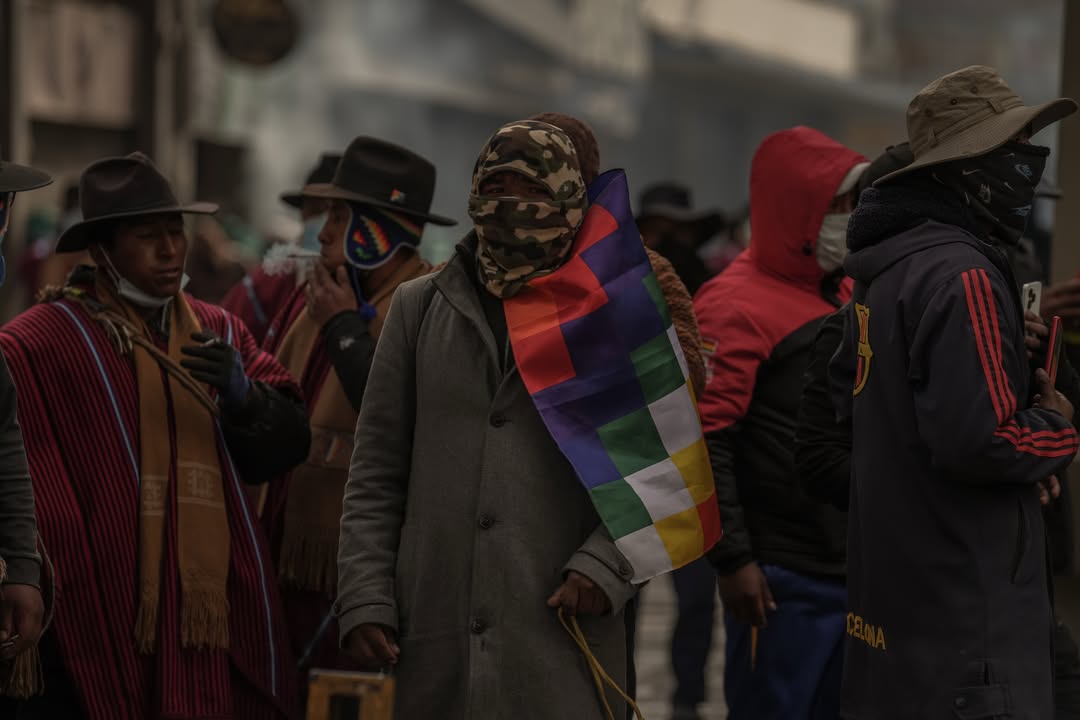
Translation by Crisis Mirror
Link to original article: https://www.facebook.com/quya.reyna/posts/pfbid0WU9a4PhCt1RofxzDnUoVkRPh9Ny2YM5NtpNQXVZecERu8UFoAVopN4bw3sSrBDmbl
In 2003, the social conditions that made a broad and cohesive mobilization possible were very different from those of today.
Before the “Gas War,” there was a large number of protests and demands piling up on the presidents’ desks. There was better union organization, greater commitment from the mining sectors, stronger conviction, more effective rhetoric, and more consolidated leadership.
There was, moreover, another important factor in El Alto—what I call “democratized poverty”: living conditions were remarkably similar. Inequality permeated every aspect of daily life, and that shared experience of exclusion fostered, perhaps, a much stronger collective consciousness than exists today.
I must point out this: the economic agendas of social movements, particularly those in El Alto, have always encompassed the entire country; they were never regional or local agendas, but rather national ones. Nationalization, for example, benefited the entire country through hydrocarbon revenues—are you going to tell me that the boom discriminated against any other department in Bolivia? In fact, Tarija was the department that benefited the most in terms of revenue.
That said, this struggle was led by the people of El Alto, as the clashes were concentrated there, leaving many dead and wounded. Nevertheless, the victory was a national one. Thanks to this struggle and the resulting political, social, and economic reforms, many people were able to buy a home, purchase a car, start a business, receive subsidies, attend better schools, enjoy paved roads, access clean water, obtain loans, and pursue professional careers.
It may not have been perfect, but Bolivia has changed. And with that transformation, its people have changed as well: an indigenous or working-class middle class—whatever you want to call it—has emerged and now makes up a large part of Bolivian society.
In El Alto, that “democratized poverty” that once affected almost all of us equally no longer exists. And this didn’t happen only in El Alto, but throughout Bolivia; society became more heterogeneous, more urban, and also more fragmented, and as a result, daily life began to revolve around work, consumption, entrepreneurship, or individual survival, because this is also a population that must survive, as it has economic capital to sustain, especially during an economic crisis.
Because of this, many people today do not feel represented by the protests; there is frustration over the roadblocks and the violence they cause. In 2003, there were also clashes, looting, and the burning of buildings, even by students. But there was greater support, ranging from the media to workers, despite the violent and critical situation. The key difference from 2003 was that we no longer had anything left to lose.
The quality of life was subhuman, difficult, dire, and harsh. For example, in El Alto, children died from malnutrition, health problems, or medical negligence; I lost three siblings. People committed suicide by taking rat poison. Women suffered from anemia. Men had to go back and forth to the fields to harvest. If death was breathing down our necks, then why not fight the final battle?
I’m not romanticizing this, but in El Alto, you’ll always hear these phrases in conflict situations: “Let them kill me,” “I’m not afraid,” “I’d rather die.” I once wondered how my mom isn’t afraid to confront the military, yet she’s so scared to get on an escalator. Sometimes I wish I had that kind of courage, which to me is inexplicable. And precisely because it’s hard to understand, the easiest explanation for other is to say that everything is “paid for,” “funded,” or manipulated. There could be exceptions, of course, but the reality is that there’s a bigger motive behind it.
Because, in reality, the mobilized Aymara people—unlike FENCOMIN or the teachers’ union, for example—aren’t even asking for special privileges or immediate benefits for themselves. Listen to the people. What they’re expressing in their speeches is something else entirely: the fear of returning to a country where they once again have no decision-making authority, no representation, and no political power.And when they talk about “race,” they’re not referring to biological characteristics, but to a racial hierarchy in which they have been at the bottom because of the color of their skin and their origins.
When Evo Morales appointed “white” ministers to his cabinet, those who are protesting today didn’t object, because power isn’t just about the person, but about the decisions they make. When Rodrigo Paz appointed his cabinet, there wasn’t an automatic outcry either. They let him govern. But little by little, signs began to emerge—in political discourse, in economic decisions, and even in power alliances—that for many of us signaled a return to a country where the working class is once again merely a source of labor, but not a force to be reckoned with.
Today’s fractured Bolivia is no longer the Bolivia of 2003, because the social classes are not the same, because the political conditions are not the same, but also because the people who are at odds today are not the same.
It is no longer Indians against q’aras (whites and mestizos from urban areas), but Indians against Indians. Those who wish for the “death” of their peers or hurl insults like “indio de mierda” often have the same dark complexion as those they despise. This shows that the divide is no longer merely racial, but a conflict over class, political allegiances, economic capital, and above all, territory: the countryside versus the city.
And this didn’t start today, but back in 2019, and the Paz administration is using it to its advantage to direct all the anger toward the protesters. The city didn’t eliminate the indigenous people; it transformed them, turning them into merchants, professionals, soldiers, civil servants… while the contempt continued to grow silently, only now it is freely expressed.
